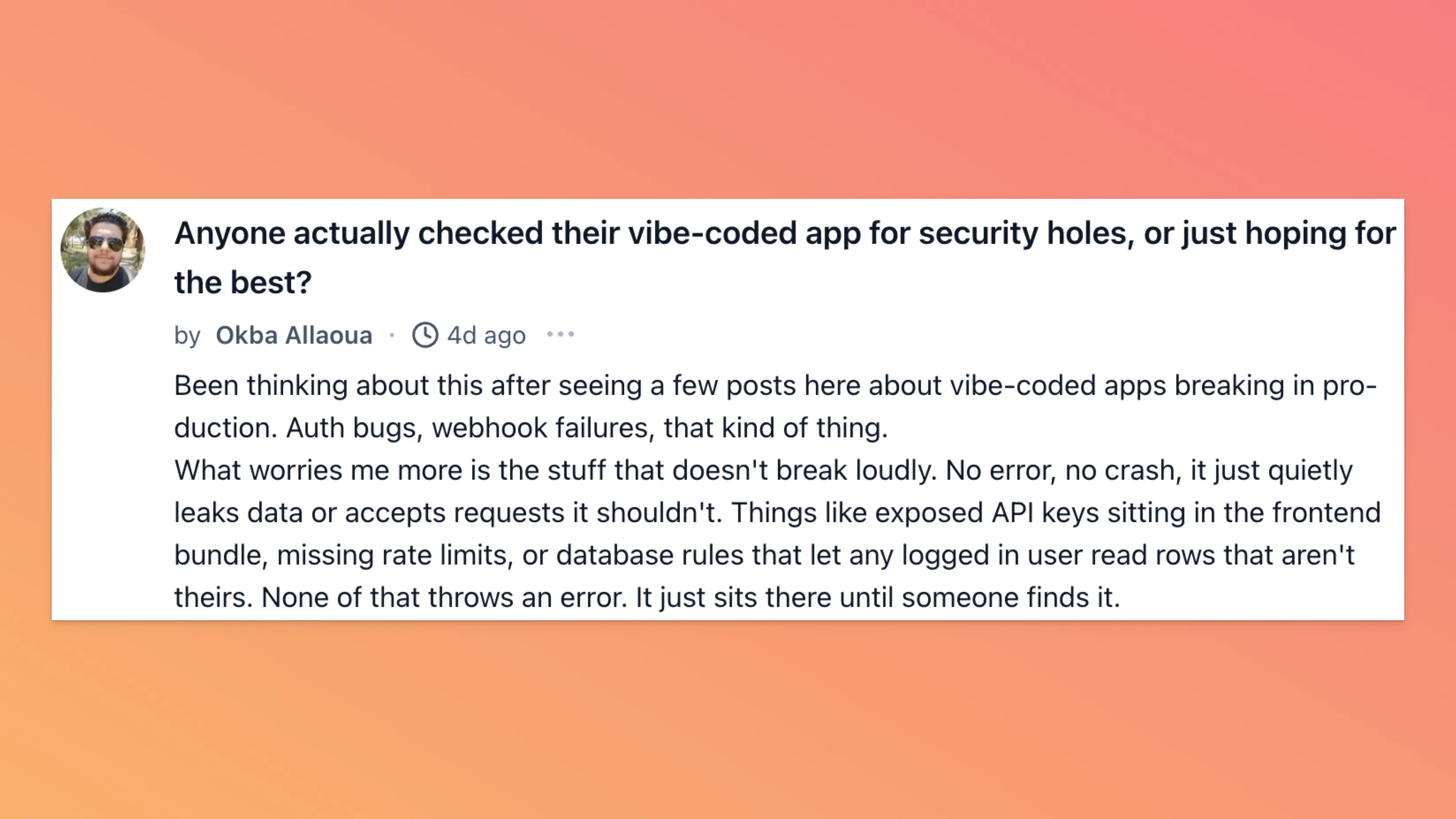
Okba Allaoua (@elhart05) asked the thing people skip: what does your actual security check look like before you launch a vibe-coded app? His framing is the right one: the scary bugs aren't the ones that crash. They're the ones that quietly work exactly as an attacker hopes.
Nobody had a settled workflow. The best reply came from Christian (@actuallydone), who found a real cross-user data leak by running targeted AI audits — not a general "review my code" prompt, but specific falsifiable questions: show me what happens when user A requests user B's record ID, show me the raw ciphertext in the database. His rule: don't trust a description of the fix, get the artifact. Chalermpon (@vollos) added a precise technical point about database row security: toggling the policy on isn't the same as testing it. You have to log in as a user who has access and try to read rows that aren't theirs, not just test as a user who's locked out entirely.
Okba's own line is the one that sticks: "A crash is annoying but at least it's honest — it tells on itself immediately. The stuff that just works quietly in someone else's favor can sit there for months, and by the time it does show up it's not a bug report, it's a breach."



 65 •
65 •
 Open Source