|


Latest Emails from producthunt
See moreproducthunt
2:30 PM (Yesterday)
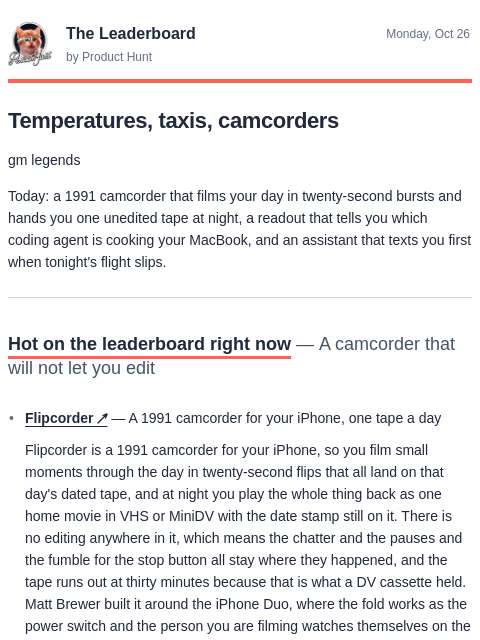
Flipcorder films your day in twenty-second bursts and gives you one unedited tape at night. Product Hunt The Leaderboard Monday, Oct 26 by Product Hunt Temperatures, taxis, camcorders gm legends Today:
producthunt
Sun 5:16 PM
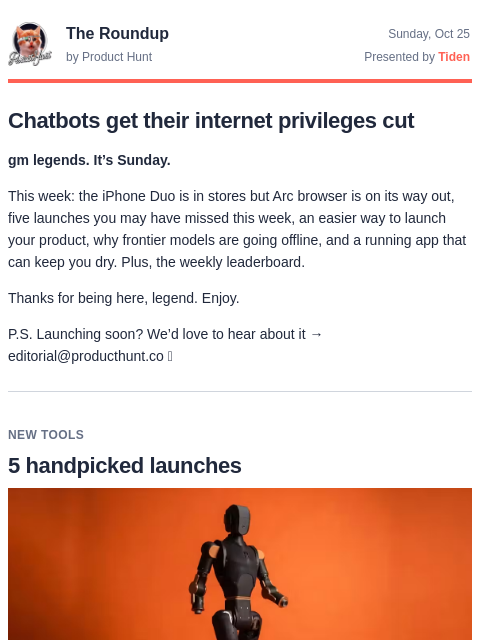
Chatbots get their internet privileges cut Product Hunt The Roundup Sunday, Oct 25 by Product Hunt Presented by Tiden Chatbots get their internet privileges cut gm legends. It's Sunday. This week:
producthunt
Sun 2:28 PM
A Mac focus timer you start by physically pulling a cat's paw, and there are eight of them. Product Hunt The Leaderboard Sunday, Oct 25 by Product Hunt Badges, song ads, paws gm legends Today: a
producthunt
Sat 2:27 PM
John borrowed his dad's old five-disc changer to record the sounds, and now it lives on a folding phone. Product Hunt The Leaderboard Saturday, Oct 24 by Product Hunt Monitors, routes, discs gm
producthunt
Fri 2:32 PM
ElevenLabs tuned the whole voice stack together and got first audio down to 570 milliseconds. Product Hunt The Leaderboard Friday, Oct 23 by Product Hunt Turn-taking, twelve seconds, color tags gm
producthunt
Thu 2:28 PM
Bengeekly bet a KitKat on every day he skipped the coworking space. It worked until he travelled. Product Hunt The Leaderboard Thursday, Oct 22 by Product Hunt KitKats, sandboxes, silence gm legends
producthunt
Wed 2:28 PM
Describe the gift box you never got round to making and UseIt hands back a file a factory can read. Product Hunt The Leaderboard Wednesday, Oct 21 by Product Hunt Gift boxes, desk pets, routing gm
producthunt
Tue 9:15 PM
Anthropic split Gemma across 15 smart TV boxes. Security researchers are not all impressed. Product Hunt The Frontier Tuesday, Oct 20 by Product Hunt Presented by Tiden Now showing on 15 screens Happy