| | Anna Fixsen, US editorIt’s little wonder that Colombia bills itself el país de la belleza – the country of beauty. The South American nation features astounding biodiversity and cultural heritage, and topography ranging from the majestic Andes and the Amazon rainforest to the Caribbean coast. I wasn’t contemplating any of this, however, when my husband and I found ourselves surrounded by a pack of cantankerous Amazon parrots during a visit to Colombia’s national aviary earlier this month, while on vacation. The green birds, known for their uncanny mimicry of human voices, had developed a cackle so diabolical and a mien so belligerent that it sent us running. (A video of the encounter went viral.) |
 |
 |
|
Our aviary excursion was just one of many memorable moments during our trip to Cartagena, a place we first fell in love with four years ago. The historic walled city, located on Colombia’s Caribbean coast, is a Unesco World Heritage Site filled with sherbet-coloured Spanish colonial buildings, abloom with bougainvillea. We like to stay at Casa del Arzobispado, a gem of a hotel located in a 17th-century building in the town’s historic walled portion. (For a taste of the vibrant Getsemaní neighbourhood and a potential sighting of its resident sloths, stay at the recently opened Four Seasons Cartagena). If you go, be sure to spend a day in the Rosario Islands. Here you’ll find private resorts (most offer day trips including transport via speedboat), white-sand beaches and crystal-clear waters, filled with coral and tropical fish. Back in Cartagena, we took it easy, dining out (La Cevichería is an all-time favourite); taking nighttime strolls along Las Murallas, the old fortresses; and taking part in the World Cup fever that swept the city. Colombia is indeed the country of beauty – be it the beautiful streetscapes or the beautiful game. Just avoid the parrots. Read on for more Weekendpaper* flits – to a 1970s Californian retreat reborn, and an architect’s private Thai haven newly open for stays – plus news of a truly portable projector for movie nights wherever you are. |
|
 |
|
|
|
 |
|
 |
|
California’s Owl House by Mickey Muenning is revamped as a retreat for empty nesters |
|
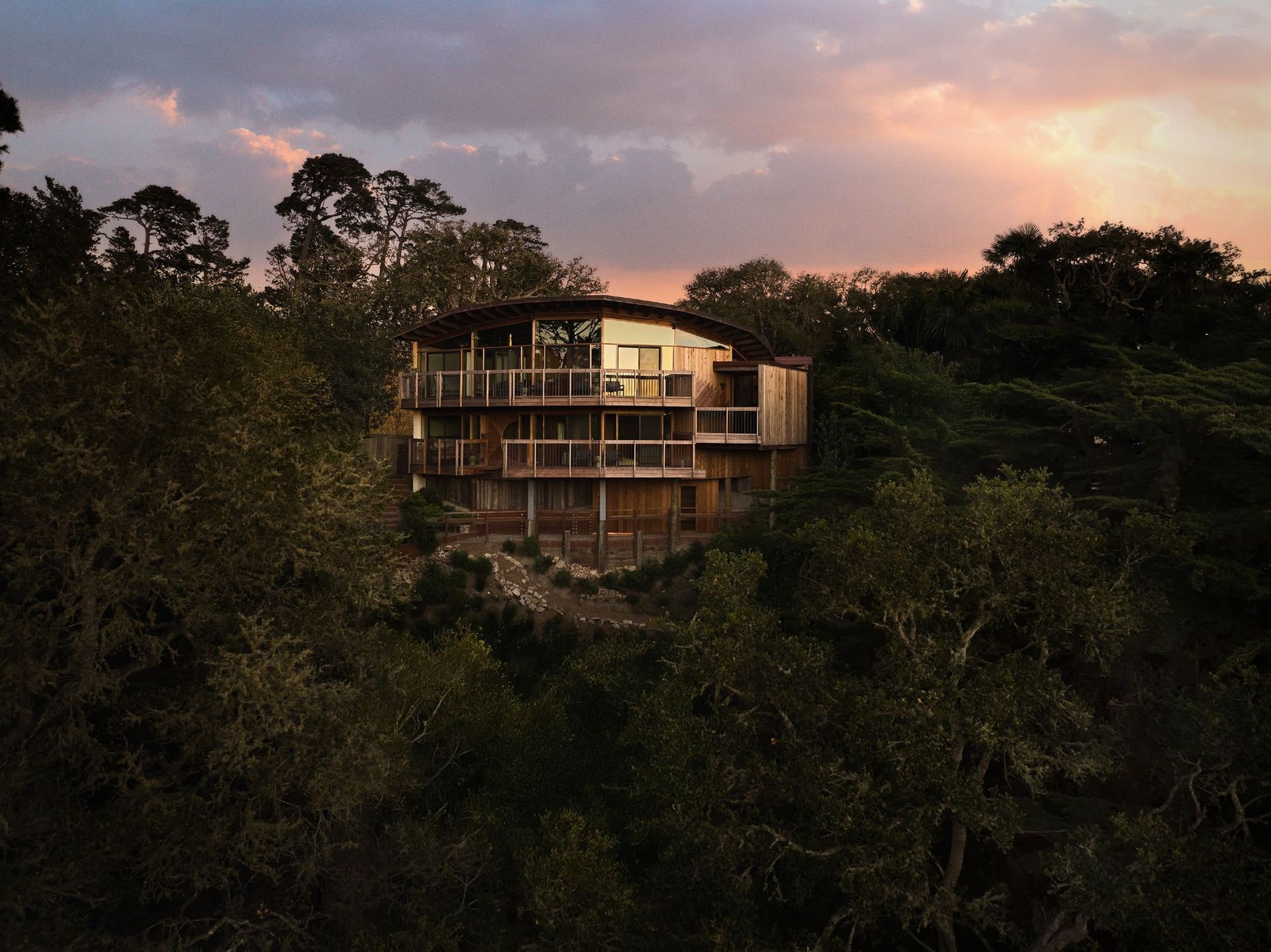
Sitting among tangles of oak and Monterey pine, on the lip of a canyon in Carmel-by-the-Sea, Owl House is part art, part architecture, its rich contradictions impossible to grasp at a glance. The redwood structure looks different from every angle – from the street, like a fox’s den hollowed out of the brush; from the canyon behind, like a massive, perched nest. Where it looms largest, however, it is also generously glazed, giving it the all-seeing gaze of its namesake. Inside, it feels exposed, enclosed and, in some places, both. Sculptural, layered and textural, it offers a series of inhabitable collages that are rigorous in their geometry, reverent toward nature, but playful nonetheless.
Designed in the early 1970s by architect Mickey Muennig – aka ‘the man who built the Big Sur’ – the house was restored in 2024 by landscape architect Bernard Trainor of Ground Studio. Then last year, its interiors were renovated by Wallpaper* US400 honoree Nicole Hollis’ San Francisco design studio for a pair of empty nesters, who use it as a weekend retreat. Shonquis Moreno wings her way over for an Owl House tour.
|
|
Olalekan Jeyifous reimagines the past to propose a promising alternative future |
|
Olalekan Jeyifous is a builder of provocative futures. For ‘Hydricosmic Litanies’, a new solo exhibition at the Walker Art Center (opening 6 August), the Brooklyn-based artist, a trained architect and a Wallpaper* US400 honoree, imagined a society in Minneapolis that evolved around the ecology of the Mississippi River, which flows through the heart of the city. Working like an archaeologist discovering and documenting this culture, Jeyifous created digital collages of the cityscape, with highways that once displaced Black neighbourhoods transforming into waterways that sustain aquaculture, travel and housing. A series of 3D-printed sculptures depict the industrial, technical and cultural artefacts that this society produced and deities that protect them. ‘I’m always dusting off the fragments and figuring out who lived there, what they looked like, and what was important to them,’ he says.
Jeyifous’ worlds emerge from different parameters and narratives, but they share throughlines: communal societies, close relationships between people and natural ecosystems, and joyful Black life. Diana Budds met him to find out more.
|
|
Stay at architect Bill Bensley’s personal Eden in Thailand |
The Bangkok-based American architect and designer Bill Bensley and his husband, horticulturalist and landscaper Jirachai Rengthong, have been building their private weekend retreat in the Mae Rim valley north of Chiang Mai for the better part of two decades – layering rooms, gardens, art collections and a suspension bridge over a river into something that defies straightforward description.
Hacienda Botanica is 16 hectares of Northern Thailand wrapped in a Mexican aesthetic: thick terracotta walls, shaded courtyards, casitas scattered across grounds of remarkable botanical richness. It has never been available to anyone except its owners and their guests – till now. Luxury travel company Smiling Albino has begun to offer the estate as an exclusive buyout. Eleven bedrooms, one valley, no other guests. Daven Wu checks in.
|
|
| |