| | Bill Prince, editor-in-chiefWallpaper* is nothing if not future-focused, brought into sharper relief as we approach 2026, marking the 30th anniversary of our print launch (September 1996). For close to two decades now, Wallpaper* has used the first issue of the year to show our support to a new generation of designers. On newsstands this week, our January 2026 Next Generation issue continues that tradition. |
 |
 |
|
Back in the day, finding, promoting and nurturing our creatives of the future involved scouring academic institutions to celebrate the graduate talent within. More recently, we’re aware that emerging design practitioners are following different routes into their professions, which is not surprising given that design education is becoming more difficult to access, and often excludes talent from specific territories we’re committed to exploring. For this reason, our January issue serves to identify noteworthy individuals at the start of their career, irrespective of whether they have benefited from traditional design educations, trained in workshops, chosen a mid-career life change, or simply happened upon their design skills by chance. Pick up a copy to discover some of the world’s most extraordinary young talents. For Weekendpaper*, in contrast, today is also a moment to look back and honour the career of a creative titan past – Frank Gehry, one of the most influential architects across the 20th and 21st centuries, died yesterday, 5 December. Below, long-time Wallpaper* contributor Michael Webb pays tribute. |
|
 |
|
|
|
 |
|
 |
|
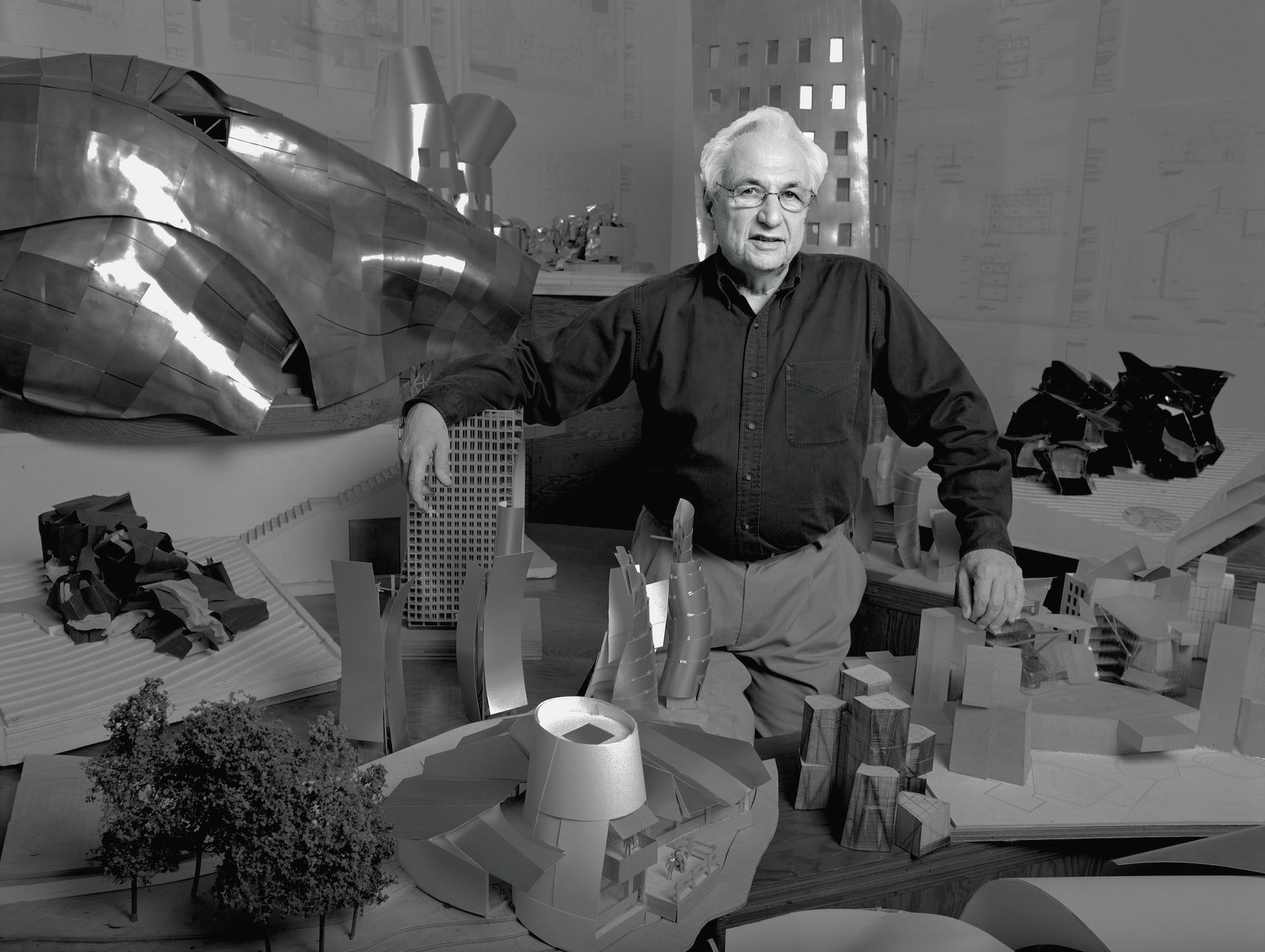
Remembering Frank Gehry, a titan of architecture and a brilliant human being |
|
Frank Gehry was the greatest architect of the past 50 years and a lovable – if sometimes cranky – human being whose passing at the age of 96 will leave a gap in the lives of his many friends.
We were never close but I consider myself blessed to have explored and written about so many of his buildings, and by his willingness to talk candidly about himself and his work. His range was extraordinary, designing an unrealised Xanadu for insurance mogul Peter Lewis and a vast Guggenheim satellite in Abu Dhabi while taking on humble tasks pro bono. Classical music was a passion and he created a dozen innovative venues, like the Pierre Boulez Saal in Berlin and the hall for the Coburn School of Music in downtown LA.
The early years were a struggle. His own house, on which he first finished work in 1978, served as a manifesto: a carapace of plywood and corrugated metal wrapped around what he called ‘a dumb Dutch colonial'. A few recognised it as a brilliant work of art but neighbours hated it and it was widely ridiculed. It now takes its place among the landmarks of 20th-century architecture. Today, his Walt Disney Concert Hall (2003) – contested by a delegation of suits when he won the commission – symbolises the best of Los Angeles just as his Guggenheim (1997) draws the world to Bilbao. Those two buildings and the 1989 Pritzker Prize cemented his reputation worldwide, but without turning his head. He continued to work in the same hands-on, intuitive way that he always had, a sense of artistry and craft infusing almost everything he did. |
|
20 things that positively delighted us in and around Design Miami |
|
Since Design Miami first launched in 2005, collectible design has been catapulted onto the global stage. This week’s been proof, with some 80 international exhibitors congregating beneath a sprawling tent in Miami Beach, and a version of the fair announced for Dubai in 2027, joining the existing Paris offshoot.
The theme for the fair, which runs through Sunday, is ‘Make. Believe.’, or as Design Miami CEO Jen Roberts put it, ‘a celebration of the extraordinary power of design to turn imagination into reality’.
We’ve been on the ground all week, amidst this whirlwind of creativity, perusing booths, special installations and galleries (not to mention the greater hurricane that is Miami Art Week). If there’s a common denominator, it’s their ability to ignite the imagination and their sense of fun. Anna Fixsen reports on highlights including covetable 20th-century masterpieces, a tower made from ceramic pickles and a chair back imprinted with Batman’s abs of steel.
|
|
Jaipur is having a creative renaissance – visit the Pink City reimagined |
|
In the heart of Rajasthan, where sandstone walls still carry the breath of centuries, Jaipur stands as a place where past and present glow together in shades of pink. Once a royal stronghold and now a laboratory of creativity, its streets bustle with unruly rickshaws even as they echo the grandeur of kings. From the filigreed Hawa Mahal palace to new design-forward restaurants, from the astronomical wonders of observatory site Jantar Mantar to sleek boutiques, and the City Palace where Mughal and Rajput aesthetics merge, the Pink City wears its heritage like an heirloom while stepping confidently into the future. ‘Jaipur has always attracted artists from across cities and countries; that’s what has led to the city’s rich cultural heritage,’ says His Highness Maharaja Sawai Padmanabh Singh of Jaipur, known as Pacho to his friends, HH to his team, and the ‘Gen Z maharaja’ to the international press. A polo player graduated in cultural heritage management and art history, he is intent on steering Jaipur toward global relevance in craft and contemporary design. Cristina Kiran Piotti dives into the city’s eclectic creative scene. |
|
|
| |