|
Thanks for reading The Abstract. This month’s edition is
1,176 words, about a
4-minute read.
|
|
Is there a topic that you’d like to see more of in
The Abstract? Drop us a line at
abstract@elysiumhealth.com. Want to get
The Abstract in your inbox? Sign up
here.
|
|

|
|
|
|
September is Healthy Aging Month—a fitting time to ask not only how long we can live, but how science might help us preserve health and function along the way. In this edition of
The Abstract: an AI-designed drug moves six biological aging clocks, semaglutide reveals effects in older mice that calorie restriction alone cannot explain, three minutes of sprinting transforms the molecular landscape of the blood, “intrinsic capacity” emerges as a potential measure of healthspan, and a large study connects the timing of our first meal with longevity.
|
|
|
Could GLP-1 drugs slow aging?
|

|
|
|
|
Semaglutide, a GLP-1 receptor agonist, suppresses appetite, and eating fewer calories can extend lifespan in mice. So when researchers gave the drug to healthy 20-month-old female mice—roughly equivalent to 60-year-old humans—they wanted to know whether it could do anything more. Semaglutide-treated mice ate 24% less and lived 12% longer, reaching a median lifespan of 834 days versus 742 days for untreated controls. Mice fed the same reduced number of calories lived about as long, making it unclear whether semaglutide extended lifespan through effects beyond appetite reduction. But the semaglutide group performed better on spatial memory and several other measures of function—suggesting that some healthspan benefits may not be explained by eating less. Currently there is no evidence suggesting the same results could be extrapolated to humans.
|
|
|
The Expert’s Take:
|
|
“The paper from Danica Chen and Will Bohr shows that semaglutide (Wegovy) extends the life span of mice when given late in life (20 months). By a thorough set of physiological and molecular analyses, the authors convincingly show a strong overlap of the effects of the GLP-1 activator and the diet of calorie restriction. These include increased physical activity and dexterity, mitigation of aging phenotypes of stem cells, increases in NAD+ and expression of sirtuin genes, decreased IGF-signaling and improved insulin sensitivity, just to name a few of the many tests performed. Are there any differences between calorie restriction and semaglutide treatment? Mice on calorie restriction eat their food instantaneously when it is provided, while the drug-treated mice eat it at a leisurely pace. The former crave food, while the latter tolerate it. In humans, volunteers for calorie restriction trials are hard to find, while doctors are bombarded by frantic petitioners for semaglutide prescriptions.”
|
|
Leonard Guarente, Ph.D.
|
|
Novartis Professor of Biology at MIT and Elysium co-founder and chief scientist
|
|
|
|
|
THIS MONTH
|
|
What We’re Reading
|
|
These are third-party articles about science that we find interesting but have no relationship to Elysium or any of our products. Elysium’s products are not intended to screen, diagnose, treat, cure, or prevent any disease.
|
How three minutes of sprinting changes your blood
For the body, three minutes of all-out effort can look very different from 90 minutes at a steady pace. In young, healthy adults, six 30-second cycling sprints altered nearly one-quarter of the proteins measured in the blood; moderate cycling changed less than 0.25%. Many of those proteins were associated with better cardiovascular and metabolic health in data from roughly 50,000 UK Biobank participants. Blood collected after the sprints also changed gene activity in fat cells, suggesting that circulation carries exercise signals between tissues. This does not make sprinting “better” than moderate exercise, and the demanding protocol may not be appropriate for everyone. But the study suggests that, for people who can exercise intensely, brief bursts activate a distinct layer of the body’s response to movement. (Cell Reports Medicine)
|
|
|
|
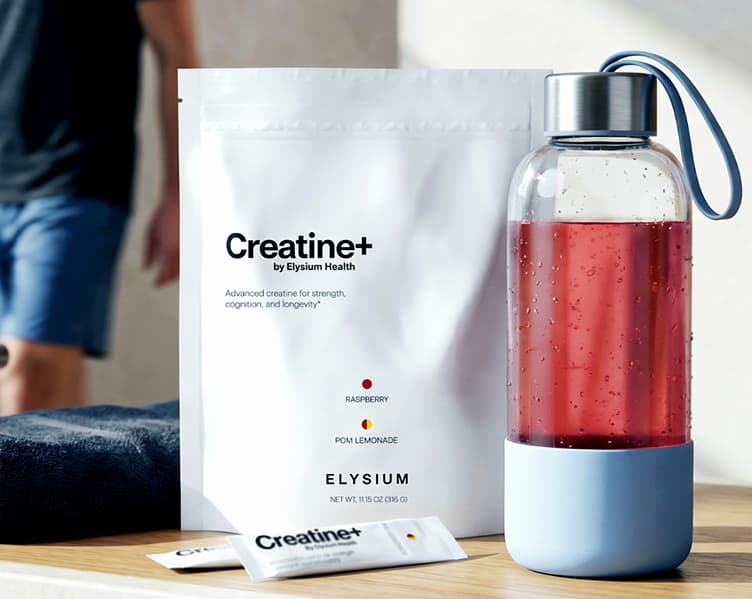
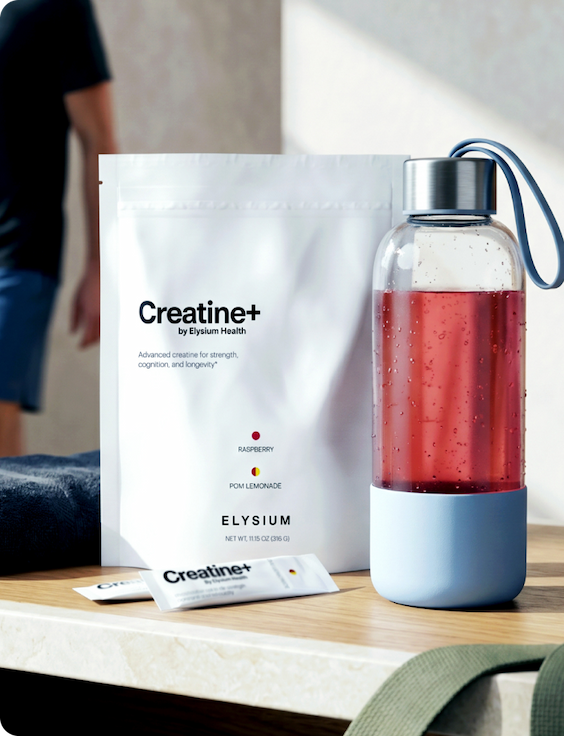
Amplify your exercise with Creatine+
|
|
You bring the effort. Creatine+ brings a 3-in-1 creatine system for longevity, strength, and cognition.
|

|
Build strength that lasts
|
|
|
|
Recover faster
|
|
|
|
Power cellular energy
|
|
|
|
Support cognitive function*
|
|
|
|
|
*Brain creatine increases have been demonstrated at 20 g/day doses.
|
|
|
|
|
|
|
|
|
Intrinsic capacity: Another measure for how you’re aging
|
|
Chronological age tells us how long someone has lived. Biological age can reveal how quickly the body has aged at a molecular and physiological level. Now researchers are developing a complementary measure of how that aging shows up in life: what a person can still do. “Intrinsic capacity,” introduced by the World Health Organization, combines cognition, mobility, sensory ability, psychological well-being, and vitality. Lower scores have been associated with disability and mortality, and studies are testing whether declines can be detected early enough to intervene. ARPA-H is also exploring intrinsic capacity as an endpoint for healthspan trials, alongside biological measures of aging, without waiting decades for lifespan data. The approach is not yet standardized. But together, biological age and intrinsic capacity could connect what is changing inside the body with how well a person is actually aging. (The New York Times)
|
|
When to eat breakfast for longevity
|
|
Breakfast advice usually focuses on what to eat. A large study suggests the clock may matter, too. Among 31,044 U.S. adults age 40 and older, mortality rose as the first meal moved later: Compared with eating between 7 and 8 a.m., the risk of death from any cause was 10% higher between 8 and 10 a.m. and 29% higher after noon. But this is not a prescription for a 7 a.m. breakfast. Food timing came primarily from a single day of recall, and eating late could reflect poor sleep, shift work, illness, or other health-related circumstances. The daily eating window also showed no consistent link with mortality once researchers accounted for when eating began. The useful takeaway is not a universal mealtime, but a reason to look beyond fasting hours and consider how regularly—and how well aligned with our daily rhythms—we eat. (European Journal of Clinical Nutrition)
|
|
An AI-designed drug sent six aging clocks backward
|
|
In a 12-week phase 2a trial, an AI-designed drug for idiopathic pulmonary fibrosis reduced predicted biological age across six protein-based aging clocks in 42 participants. The findings don’t prove the drug slows aging, but they point to a new way to study it.
“This is one of the few concrete examples of a drug largely designed with generative AI,” says Mark Gerstein, Ph.D., Albert L. Williams Professor of Biomedical Informatics at Yale and a member of Elysium’s Scientific Advisory Board.
“Moreover, it's impressive to see how AI was used throughout the whole drug-development process, from upstream target finding to analyzing the downstream trial for results related to longevity.” He adds:
“This last use has great promise for aging research, showing how conventional disease trials can be made into dual-purpose designs suitable for studying longevity.” (Nature Biotechnology)
|
|
|
|
|
TERM OF THE MONTH
|
|
Healthspan
|
|
/ˈhelth-ˌspan/
|
|
The portion of life spent in good health, with physical and cognitive function intact. Unlike lifespan, which measures how long we live, healthspan considers how well we live during those years.
|
|
|
|
|
|
AGING 101
|
|
What is your biological age—and why does it matter?
|

|
|
|
|
Chronological age counts how long you’ve been alive. Biological age is an estimate of how your body has aged, based on measurable changes that reflect genetics, lifestyle, environment, and health. Learn how scientists calculate biological age, why different parts of the body may age at different rates, and what tracking it over time can—and cannot—tell you. (Read more)
|
|
|
Stay connected with Elysium via text
|
|
|
|
|
Stay connected with Elysium via text
|
|
Sign up for texts to get product news, longevity insights, exclusive offers—and 15% off any new subscription.
|
|

|
|
|
|
|
|
|