Thanks for reading The Abstract. This month’s edition is
1,259 words, about a
4-minute read.
Is there a topic that you’d like to see more of in
The Abstract? Drop us a line at
abstract@elysiumhealth.com. Want to get
The Abstract in your inbox? Sign up here.
|
|

|
|
|
|
May is Women's Health Month, and we're opening the issue with a new pilot study showing that raising NAD+ may ease some of the most disruptive symptoms of perimenopause—hot flashes, bloating, and disrupted sleep. Also in this issue: a Yale study finding that a meaningful share of older adults improve, not decline, with age; an RCT showing that even moderate resistance training slows brain aging; new research linking aging anxiety to epigenetic aging in midlife women; and an early look at NAD+ as an immune-regulatory lever in autoimmune disease.
|
|
|
Could NAD+ ease the symptoms of perimenopause?
|

|
|
|
For up to 80% of women, the menopause transition brings hot flashes that can last a decade, alongside bloating and disrupted sleep—symptoms tied to declining estradiol. Hormone replacement therapy is the standard of care, but it carries known risks and isn't right for every woman. A new pilot study from researchers at Elysium Health, Emory University School of Medicine, and the University of South Alabama suggests an alternative or complementary approach: restoring NAD+ levels to support estradiol production.
After just seven days on
Basis (250 mg nicotinamide riboside and 50 mg pterostilbene), 75–91% of symptomatic participants reported improvements in the frequency or unpleasantness of bloating, hot flashes, and poor sleep.* Urine analysis showed a significant rise in the estradiol-to-estrone ratio, consistent with the proposed pathway: NAD+ supplementation increases NADPH, the cofactor required to convert estrone to the more potent estradiol.
The authors note that a longer, placebo-controlled follow-up is warranted. But the speed of response and the alignment between symptom data and hormonal mechanism point to an NAD+-based path that may give women in perimenopause a non-hormonal option worth investigating further.
|
|
|
The Expert’s Take:
|
|
“NADP(H) levels decline with oxidative stress and aging, shifting the relative abundance of estrone and estradiol towards estrone and estrogen conjugates. Increasing estradiol levels through supplementation to alleviate perimenopausal and menopausal symptoms also increases estrone levels. A premise of this work has been that
Basis would provide a means to alleviate the decline in NADPH and favor the reduction of estrone to estradiol, thereby achieving a more natural approach to addressing menopausal symptoms. In this study, we show that even after only a few days of taking Basis, estradiol-to-estrone ratios improved, and this shift was associated with reduced frequency and intensity of menopausal symptoms among Basis study participants. Furthermore, by examining whether Basis supplementation altered the NAD metabolic profile, we identified and characterized a new vitamin B3 degradation product. This discovery offers new mechanistic insights into how NAD precursors, such as Basis, are used and processed in the human body.
On a personal level, using Basis has been life-changing for me—one morning dose helps keep hot flashes at bay day and night, while significantly improving my sleep.”
|
| Marie Migaud, Ph.D.
|
|
Professor, Department of Pharmacology, College of Medicine | Professor of Oncologic Sciences, Mitchell Cancer Institute | University of South Alabama
|
|
|
|
|
|

|
|
Hot flashes. Bloating. Disrupted sleep.
|
|
New research suggests Basis may help ease perimenopause symptoms and support the body’s natural hormone balance by restoring NAD+ levels.* Basis is clinically proven to
raise NAD+ by 40% in just 30 days.
|
|
|
|
|
|
|
THIS MONTH
|
|
What We’re Reading
|
|
These are third-party articles about science that we find interesting but have no relationship to Elysium or any of our products. Elysium’s products are not intended to screen, diagnose, treat, cure, or prevent any disease.
|
|
Why some people get better with age
|
|
|
A new analysis of more than 11,000 older Americans in the Health and Retirement Study challenges the assumption that later life is a uniform downward slope. Over up to 12 years of follow up, 45% of participants improved in cognition, walking speed, or both—gains that disappear when researchers look only at group averages. The improvements weren't limited to people rebounding from illness; many had normal function at baseline and got better. The study also found that participants with more positive beliefs about aging were significantly more likely to show those gains, even after adjusting for age, sex, education, chronic disease, and depression. How people think about getting older, the findings suggest, may be an approachable intervention to changing how they age. (Geriatrics)
|
|
How worrying about aging may shape aging itself
|
|
A new study in
Psychoneuroendocrinology analyzed 726 midlife women from the Midlife in the United States (MIDUS) study and found that anxiety about aging—specifically worry about declining health—was associated with accelerated
epigenetic aging, as measured by the DunedinPACE clock. Anxiety about losing attractiveness or fertility showed no significant association. The link weakened and lost significance when researchers adjusted for health behaviors like smoking and alcohol use, suggesting that aging anxiety may shape biological aging partly through the coping behaviors it drives. The findings, the authors note, identify aging anxiety as a measurable and modifiable psychological factor—and a reminder that mental and physical health in midlife are more entangled than they're often treated. (Psychoneuroendocrinology)
|
|
DNA repair and cold exposure linked to longevity in Bowhead whales
|
|
In a landmark study published in
Nature, researchers investigated cell fibroblasts of the bowhead whale, a mammal that lives over 200 years, and uncovered a surprising longevity strategy: bowhead whales display exceptionally high-fidelity DNA repair. Despite the lifespan of a bowhead whale and its many cells, it is not cancer prone. Paradoxically, it has been found that relatively few oncogenic mutations are needed to create cancer in the animal. The conclusion of this study is that bowhead whales are champions of DNA repair before mutations form. In addition, they express very high levels of cold-inducible RNA‐binding protein (CIRBP). Cell fibroblasts from the whales exhibit fewer mutations, more accurate repair of double‐strand breaks, and reduced inflammatory senescence signalling compared to human or mouse cells. Long life in large mammals may stem from repair, not detection and elimination of defective cells. This suggests genome-maintenance proteins like CIRBP might offer new pathways to enhance human healthspan. (Nature)
|
|
Resistance training may slow brain aging
|
|
|
A new randomized controlled trial in
GeroScience used machine-learning "brain clocks" to measure how exercise affects brain aging in older adults. Researchers randomized 309 participants aged 62–70 to heavy resistance training, moderate resistance training, or a non-exercise control, with brain MRI scans at baseline, one year, and two years. Both training groups showed a reduction in brain age of 1.4–2.3 years compared to baseline; the non-exercise group showed no change. Notably, moderate-intensity training produced effects roughly equivalent to heavy training, and the benefits persisted at the two-year follow-up—a full year after the supervised program ended. The findings add to a growing case for resistance training as a modifiable lever for brain health later in life. (Geroscience)
|
|
|
|
|
|
TERM OF THE MONTH
|
|
Estradiol (E2)
|
|
/ˌes-trə-ˈdī-ˌōl/
|
|
Estradiol (E2) is the most potent of the body's three estrogens and the dominant one during a woman's reproductive years—central to skeletal, vascular, and metabolic health. As women approach menopause, estradiol levels fall and a weaker estrogen, estrone (E1), takes over. The enzyme that converts estrone back to estradiol depends on a cofactor called NADPH, which in turn is made from NAD+—a molecule that declines with age. That connection is the basis of this issue's lead study: raising NAD+ shifted the estradiol-to-estrone ratio upward in women with menopausal symptoms, alongside meaningful improvements in hot flashes, sleep, and bloating.
|
|
|
|
|
|
AGING 101
|
|
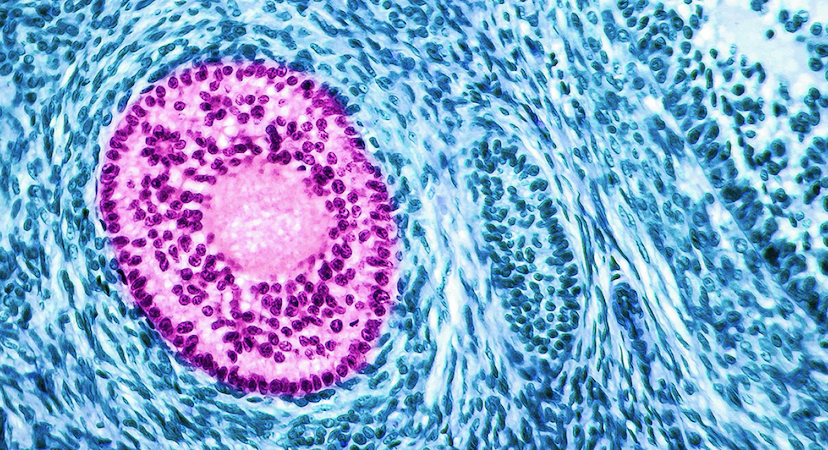
NAD+ and ovarian aging: Can it help with menopause?
|
|
|
|
|
The ovaries are amongst the first organs to age. Research has associated ovarian aging with declining NAD+ levels. Emerging research suggests boosting NAD+ levels may help slow ovarian aging at a cellular level. (Read more)
|
|
|
|